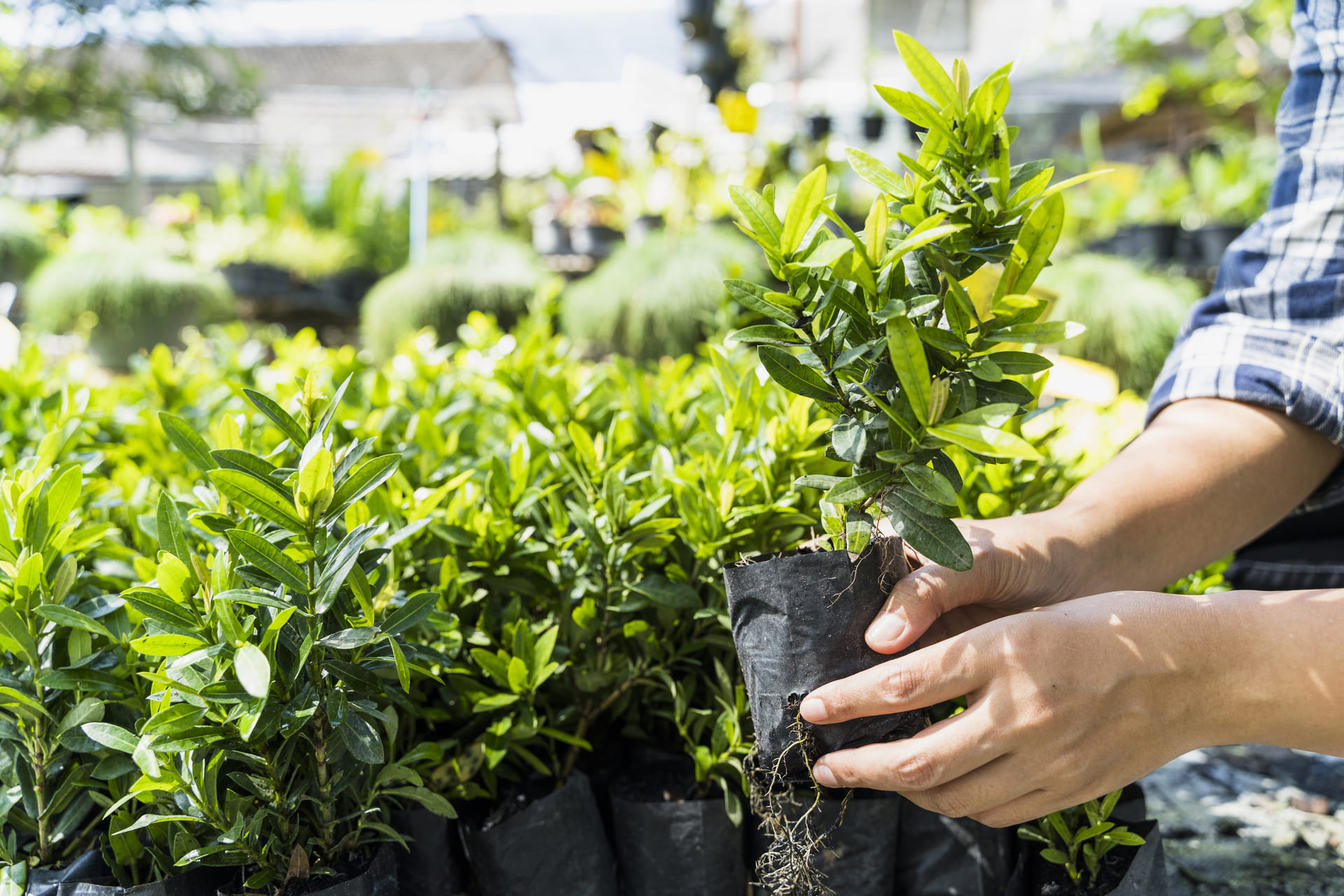


PALESTINE SWEET LIME
Names and Origin :
The Indian sweet lime is called mitha nimbu in India, limûn helou or succari in Egypt, and Palestine sweet lime to distinguish it from Millsweet and Tunisian limettas, which are also commonly referred to as sweet limes.
Fruit :
Medium-sized fruit, subglobose to oblong or short-elliptic, sometimes slightly ribbed; base evenly rounded; apex generally rounded; the areolar area often slightly protruding into a small, flat nipple surrounded by a shallow circular groove. Flesh is straw-yellow, tender, very juicy, with a mild flavor due to low acidity and a slight bitter aftertaste. Single bloom and harvest.
Tree :
Distinctive tree, medium to large in size, with a spreading but irregular growth habit, thick thorny branches, and moderately dense foliage. Leaves are pale green, medium-sized, long-oval, blunt-tipped, often slightly cupped or rolled, with petioles. Flowers are medium to large, white, and new shoots are bright green.
PERSIAN LIME
The Persian lime is a variety known for its high productivity and resistance to genetic disorders. It produces small fruits that are green when ripe, highly acidic, and aromatic.
Origin and Cultivation :
The Persian lime was selected for its resistance and is widely cultivated for commercial production of Persian limes.
Tree :
A medium-sized tree with a bushy, spreading habit and very productive. It has dense foliage and delicate flowers with a slight purple tint. Flowering occurs almost year-round.
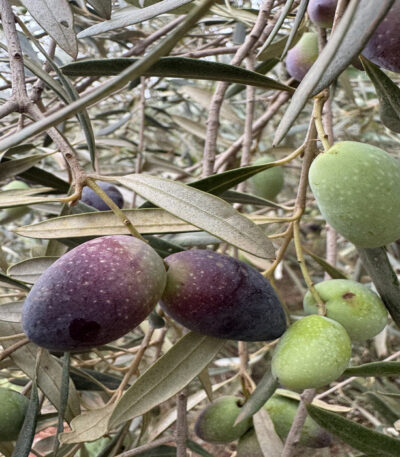
PICHOLINE DE LANGUEDOUC
The Picholine olive variety originates from southern France, mainly the Languedoc and Provence regions. It is a dual-purpose variety, used both for olive oil production and as table olives, often consumed green or black. The tree has medium to high vigor with an upright to semi-upright growth habit and adapts well to Mediterranean soils and climates. Flowering occurs in mid-season, and harvesting takes place from mid to late season. The fruits are medium to large, elongated, and slightly asymmetrical, with an oil yield of 18–20%. Picholine is highly valued for its firm and flavorful fruits, consistent productivity, and good disease resistance.
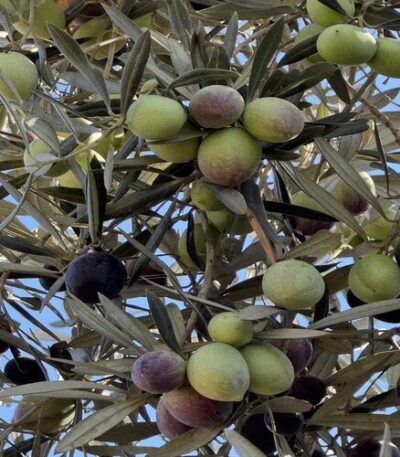
PICHOLINE MAROCAINE
The Moroccan Picholine olive variety originates from Morocco and is widely cultivated in Mediterranean regions. It is a dual-purpose variety, used both for olive oil production and as table olives, with fruits consumed green or black. The tree shows medium to high vigor. Flowering occurs in mid-season, and harvesting takes place from mid to late season. The fruits are medium to large, elongated, and uniform, with an oil yield ranging from 16 to 20%. This variety is highly valued for the firmness and flavor of its fruits.
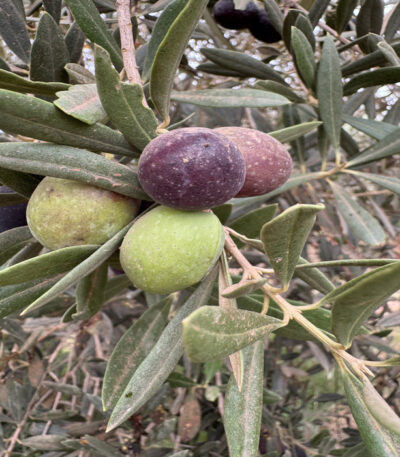
PICUAL
The Picual olive variety originates from Spain, particularly from the Andalusian region, where it is one of the most widely cultivated varieties. It is primarily used for olive oil production and is known for its high and consistent yield. The tree has medium to high vigor, with an upright growth habit and good adaptability to different soil and climatic conditions. Flowering occurs in mid-season, and the harvest is typically early to mid-season. The fruits are medium-sized, oval, and slightly pointed at the apex, with an excellent oil yield that can reach 20 to 27%. The oil produced is of very high quality, rich in antioxidants and oleic acid, with a strong, fruity flavor and a slightly bitter and pungent taste. The Picual variety is appreciated for its resistance to cold and its adaptability to intensive cultivation systems, although it can be sensitive to water stress and certain pests such as the olive fruit fly.
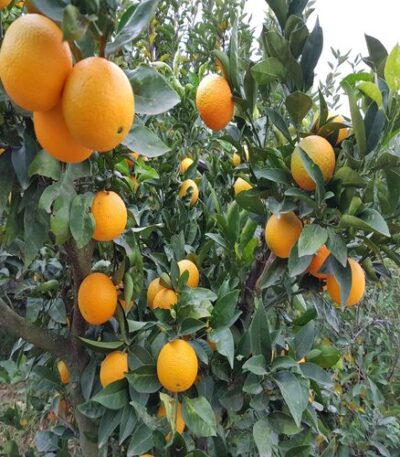
SALUSTIANA
Salustiana is a sweet orange originating from a bud mutation of the “Communa” orange, discovered and propagated by Don Salustiano Pallas in Valencia, Spain. It is an early variety, considered one of the first of the Spanish oranges, highly regarded for its fruit quality, near seedlessness, and early maturity.
Tree :
The tree is vigorous, slightly upright, medium to large in size, and very productive. Thanks to the excellent quality of its fruit, it can be left on the tree until the end of March without significant loss of taste or texture.
Fruit :
The fruits are medium to large, subglobose to spherical, with a shallow basal cavity and faint radial grooves. The rind is moderately thick and delicately textured. The flesh is tender, juicy, and particularly soft, with a rich, sweet, and aromatic flavor. The fruits are nearly seedless and maintain their quality well on the tree.
Harvest Period :
December – February
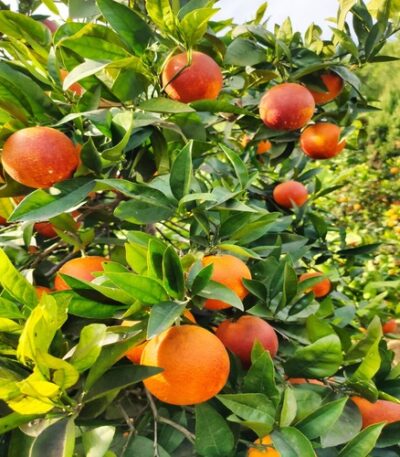
SANGUINELLI
Sanguinelli is a late midseason blood orange, originating from a mutation of Doble Fina, discovered in Almenara, Spain around 1950. It has become one of the main Spanish blood orange varieties and is highly valued for its exceptional fruit quality, intense and consistent red pigmentation, and the sweet, aromatic flavor characteristic of blood oranges.
Tree :
The tree is vigorous, medium-sized, spineless, and very productive. The fruits can remain on the tree for an extended period without loss of quality. The foliage is light green and dense, supporting good yields.
Fruit :
The fruits are small to medium, oval, and often asymmetrical, with a smooth, glossy, and highly pigmented rind. The flesh is tender, juicy, and attractively deep red. The fruits have a persistent style and may contain a few seeds. They hold well on the tree and handle storage and transport easily.
Harvest Period :
February – April
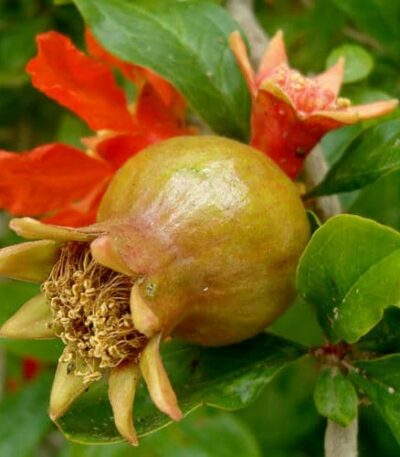
SEFRI
The Sefri pomegranate is a traditional Moroccan variety widely cultivated in Mediterranean and semi-arid regions. The tree exhibits medium to strong vigor with an upright-spreading habit and enters production early, often by the third year after planting. It shows good resistance to common diseases, including powdery mildew. The fruits are round to slightly flattened, medium to large in size, and develop a bright red color at full maturity. The arils are juicy, sweet-tart, and deeply colored, making them highly appreciated for fresh consumption as well as for juice, jams, and syrups. Harvest typically occurs from late September to October, depending on the region and climate. Sefri is valued for its high and consistent yield, low alternate bearing, excellent flavor, and good post-harvest conservation, making it suitable for both commercial orchards and home gardens.
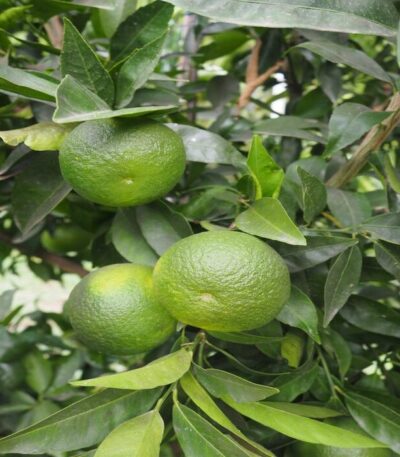
SIDI AISSA
The Sidi Aissa mandarin, a Moroccan variety derived from a mutation of the Fine Clementine, is characterized by round, well-colored, juicy, seedless fruits that are easy to peel. It reaches maturity between mid-October and late December
STAR RUBY
The Star Ruby is a grapefruit derived from irradiated seeds of the Hudson variety, developed through the breeding program of R. A. Hensz at Texas A & I University in Weslaco. It reaches maturity from February to June and is generally less vigorous than other grapefruit varieties. However, Star Ruby produces highly attractive fruits with a smooth yellow rind blushed with red, and a deep red, juicy flesh that is almost seedless. With its mid- to late-season maturity and excellent fruit-holding capacity on the tree—despite a slight loss of flesh color as the season progresses—it stands out as one of the most remarkable pigmented grapefruit varieties.
TADMAIT
The Tadmait carob tree has medium vigor and produces female-type flowers. Flowering begins in June, and at maturity, the tree can yield over 100 kg of pods. This variety is resistant to powdery mildew and does not exhibit alternate bearing. The pods of this clone have a seed content of 25.77%, with an average width of 1.37 cm and a length of 12.55 cm. Harvesting starts in July. This clone enters production quickly, already producing from the second year, and is mainly intended for seed production. Pod quality and overall yield depend on several factors, including fertigation programs and orchard management practices.
TAFOUKT
The Tafoukt carob tree has strong vigor and produces female-type flowers. Flowering begins in June, and at maturity, the tree can yield over 100 kg of pods. This variety is resistant to powdery mildew and does not exhibit alternate bearing. The pods of this clone have a seed content of 20.85%, with an average width of 1.01 cm and a length of 15.75 cm. Harvesting starts in July. Notably, the pulp of this clone is sweet, making it suitable for consumption as fresh fruit or for use in food products such as confectionery and pastries. However, the sweetness can vary depending on several factors, including climate, soil, and agricultural practices.