
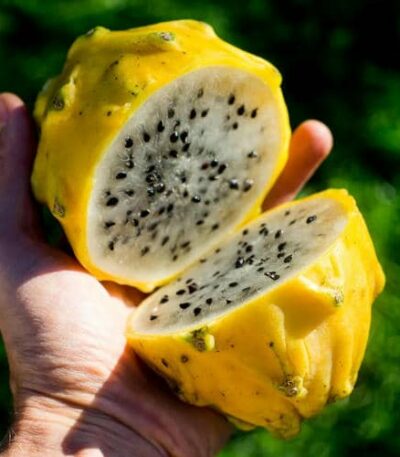
HYLOCEREUS MEGALANTHUS
The Hylocereus megalanthus, commonly known as the yellow pitaya or yellow dragon fruit, is a tropical climbing cactus native to South America, particularly Colombia, Ecuador, Bolivia, and Peru. It produces fleshy, triangular green stems that require support structures for optimal growth and shows strong drought tolerance when well-drained soil and proper irrigation are provided. The plant bears large, fragrant nocturnal flowers that are pollinated by bats or night insects and can flower multiple times per year under favorable conditions. The fruits are oval with a bright yellow skin and small spines that fall off at maturity, containing sweet white pulp speckled with tiny edible black seeds, typically weighing 150–300 g. Harvest occurs manually when fruits reach full maturity, generally from November to March in the Northern Hemisphere. The fruit is highly nutritious, rich in vitamin C, B vitamins, minerals, fiber, and antioxidants, and is consumed fresh, in juices, jams, or desserts. Valued for its exceptional sweetness and attractive appearance, Hylocereus megalanthus has high commercial potential and is increasingly cultivated in tropical and subtropical regions for both local and export markets.

HYLOCEREUS POLYRHIZUS
Hylocereus polyrhizus, commonly known as red pitaya or red dragon fruit, is a climbing cactus native to Central and South America and now widely cultivated in tropical and subtropical regions worldwide. The plant produces fleshy, triangular green stems that require support for optimal growth and demonstrates good drought tolerance when provided with well-drained soil and proper irrigation. It bears large, nocturnal, fragrant flowers that can bloom multiple times per year under suitable conditions and are pollinated by bats or night insects. The fruits are oval to slightly oblong with bright red skin and green-tipped scales, containing sweet, juicy red pulp dotted with small edible black seeds. Fruits are harvested manually at full maturity, typically from June to September in the Northern Hemisphere. Hylocereus polyrhizus is highly appreciated for its vibrant color, nutritional content rich in vitamins, minerals, fiber, and antioxidants, and its versatility for fresh consumption, juices, jams, and desserts. Its high market value and attractive appearance make it a profitable crop for commercial cultivation and export.
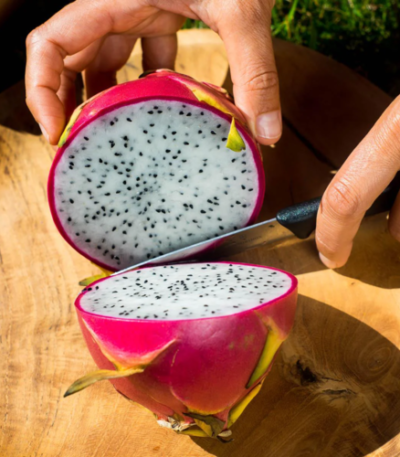
HYLOCEREUS UNDATUS
Hylocereus undatus, commonly known as white-fleshed pitaya or white dragon fruit, is a climbing cactus native to Central America and widely cultivated in tropical and subtropical regions worldwide. The plant has fleshy, triangular green stems that require support for optimal growth and demonstrates good drought tolerance with well-drained soil and proper irrigation. It produces large, nocturnal, fragrant flowers that bloom multiple times per year under favorable conditions and are primarily pollinated by bats or night insects. The fruits are oval with bright pink skin and green-tipped scales, containing sweet, juicy white pulp dotted with small edible black seeds. Harvest is done manually when fruits reach full maturity, generally from June to September in the Northern Hemisphere. White pitaya is valued for its mild, refreshing flavor, nutritional content including vitamins, minerals, fiber, and antioxidants, and its versatility for fresh consumption, juices, jams, and desserts. Its striking appearance and commercial potential make Hylocereus undatus a profitable and highly appreciated crop for both local and export markets.
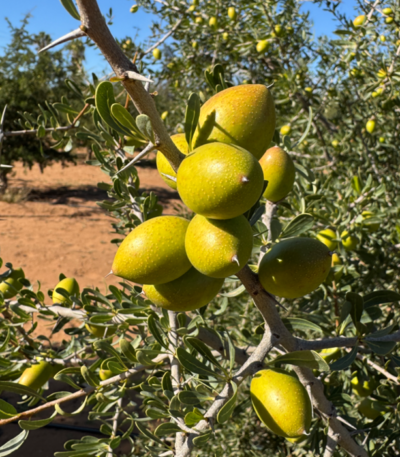
IGHALEN
The IGHALEN clone is a vigorous argan tree that flowers throughout the year, allowing for continuous production of both seeds and flowers. With few thorns and the ability to produce more than 100 kg at maturity, this variety is highly productive. Its elongated fruits are distinguished by a crushing yield of 34% and an impressive oil content of 50%, making it particularly suitable for oil extraction. The harvest period extends from October to March, providing an abundant yield during this time. As with other argan varieties, the quality and quantity of oil production depend on several factors, including fertigation practices, orchard management, planting region, and climatic conditions. Furthermore, this clone shows remarkable drought resistance, making it an excellent choice to face the challenges of climate change.
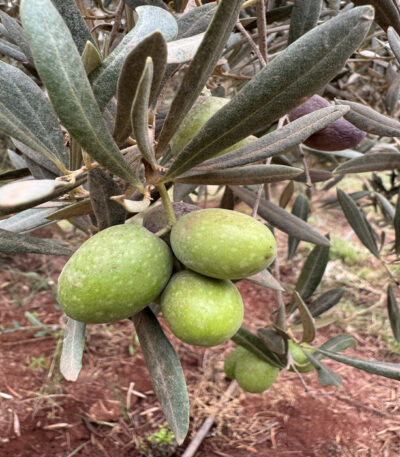
KORENEIKI
The Koroneiki olive variety originates from Greece, primarily cultivated in Crete and the Peloponnese. It is mainly used for olive oil production. The tree has low to medium vigor with a compact, semi-upright growth habit. Flowering occurs early, and harvesting takes place mid-season. The fruits are small, oval, and uniform in shape, with an oil yield ranging from 18 to 25%. The oil produced is of high quality, highly aromatic and fruity, with slightly bitter and pungent notes. Koroneiki is known for its high productivity, disease resistance, and suitability for mechanical harvesting, making it one of the most widely cultivated Greek varieties for extra virgin olive oil production.

LANE LATE
Lane Late Navel is a late-season Navel orange variety, discovered in 1950 as a bud sport of the Washington Navel on the property of L. Lane in Victoria, Australia. The tree has a rounded, slightly drooping canopy, with medium size and vigor. Its maturity occurs four to six weeks after the Washington Navel, making it an excellent choice to extend the export season for Navel oranges.
The fruit has a smoother rind and a smaller navel than the Washington Navel. The peel develops excellent color at maturity, while the flesh is firm yet tender, fairly juicy, and sweet. Its shape is round, and the harvest period extends from January to May.
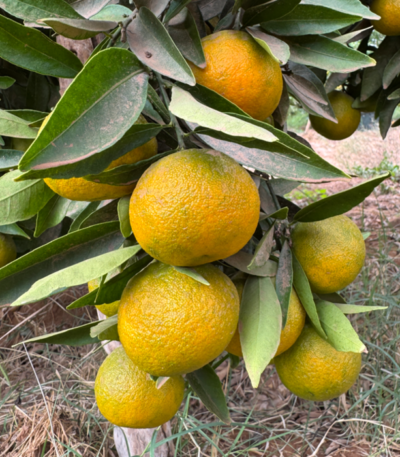
LARACHE
The LARACHE is a seasonal clementine variety resulting from a natural mutation of the Cadoux clementine, discovered in Morocco in 1984.
The tree is vigorous with dense foliage and is known for good production.The fruit is characterized by a thicker skin than Cadoux, generally large in size, yet remains easy to peel.
The harvest period extends from October to December.
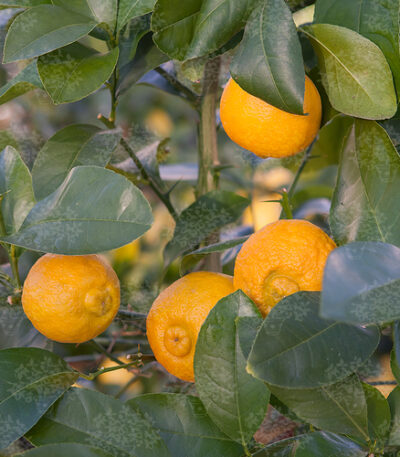
LIMONETTE DE MARRAKECH
Origin :
This fruit is native to Morocco, where it is exclusively found.
Fruit Description :
Medium-sized fruit, slightly flattened and rounded, usually ribbed. The base is rounded or somewhat flattened, while the apex is strongly flattened with a broad groove surrounding a prominent nipple.
The rind is thin, moderately dotted with sunken oil glands, slightly bumpy but adherent, and light yellowish-orange in color. The flesh is pale yellow, very juicy, highly acidic, and aromatic.
Tree Description :
A vigorous, large tree with an upright and spreading habit, slightly spiny and very productive. Its leaves resemble those of the lemon tree but are more oval, less pointed, and often slightly curved upward at the tip. The flowers, purple in bud, appear on young purple-tinted shoots. Flowering occurs throughout the year, mainly in spring.
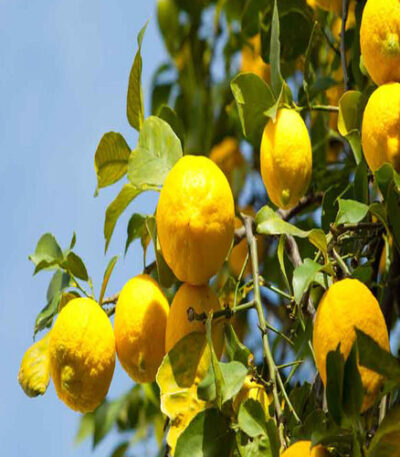
LISBON
The Lisbon lemon is a variety originating from Portugal and widely cultivated in California and other Mediterranean regions. The tree is vigorous, large, and highly productive. The fruits are medium to large in size, oblong in shape, with a thin to medium-thick peel and juice rich in acidity. Seeds are few, and the fruits are generally almost seedless. Production is spread over a long period, allowing for nearly year-round harvesting, with a peak in winter and spring.
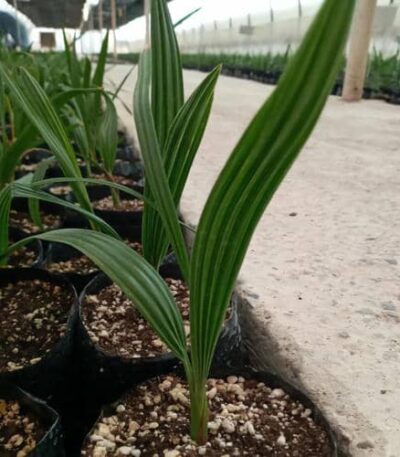
Majhoul
At our nursery, we have developed a specialized program dedicated to the production of the prestigious Medjool date palm, one of the most sought-after varieties worldwide. This activity is carried out in close collaboration with an internationally recognized laboratory specializing in in-vitro culture technology.
We import certified vitro-plants that comply with ONSSA standards of quality and traceability. Upon arrival, our technical team manages the entire acclimatization process in modern, fully controlled facilities. This crucial phase ensures a smooth transition from in-vitro conditions to natural environments, guaranteeing plant vigor and optimal survival rates.
The young plants then undergo a rigorous development program, including physiological monitoring, climate adaptation, and root system strengthening, to ensure uniform, vigorous, and field-ready date palm plants.
Through this integrated approach, we provide farmers and investors with high-quality Medjool date palm plants while contributing to the modernization and sustainability of the date palm sector in Morocco.”
MANZANILLE
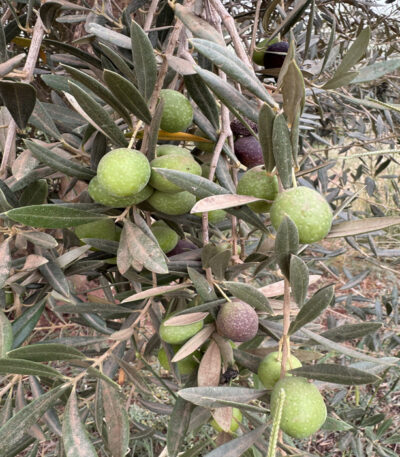
The Manzanilla olive variety originates from Spain, mainly from the Seville region. It is a dual-purpose variety, used both for olive oil production and as table olives, although its primary use is for green or black table olives. The tree has medium to high vigor with an upright to semi-upright growth habit and adapts well to Mediterranean soils and climates. Flowering occurs in mid-season, and harvesting takes place from mid to late season. The fruits are medium to large, round to slightly oval, with an oil yield of 18–20%. This variety is highly valued for its firm and flavorful flesh, consistent productivity, and disease resistance, although it can be somewhat sensitive to pests such as the olive fruit fly.
MARCH
Marsh Grapefruit is a vigorous, large-growing variety.
This variety originated as a nucellar seedling of Marsh, developed by H. B. Frost at the University of California Citrus Research Center in Riverside from seeds planted in 1916, and it was commercially introduced in 1952.
The fruit is medium-sized, oblate to spherical, with few or no seeds. At maturity, the peel is pale to light yellow, moderately thin, firm, very smooth, and even. The flesh is light beige, tender, very juicy, and has a pleasant flavor, though less intense than some seedy varieties. Marsh grapefruit is notable for its exceptional holding ability on the tree, as well as its excellent storage and shipping qualities.
The tree is vigorous, spreading, large, and highly productive. Due to its high heat requirements, Marsh grapefruit is commercially limited to very warm climates.